Monday, 15 August 2011

Information on the Aquarius?

Lynne April Bott of Willenhall UK left this message in my problematic online guestbook sometime back:-
I am trying to source information on the Aquarius, there is a possibility that my Great Uncle may have been on her when she was sunk.He was reported missing on 15th Feb1942 and reported killed in action 26th Feb1942 in Malaya.We know he got onto the wrong ship and it was sunk. My Gt. Grandmother always said it was one of churchill's mistakes. please help

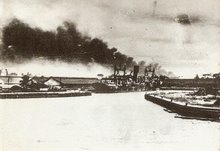
Royal Navy Floating dock Singapore

Alan Peddell born in Singapore writes:-
Together with my parents and one younger brother aged 2 ( I was nearly 4), we managed to leave Spore on a small ship which took us to Djakarta and then we boarded the ss Plancius which took us to Colombo, where we stayed until the war ended. My father was an electrical engineer working on the Royal Naval Floating Dock. As both my parents are dead now, I would like to have any information regarding the ship that might have taken us to join up with the Plancius. I understand we were delayed from leaving because my father had to assist the demolition of the floating dock, and all other large ships had left Keppel because of the heavy bombing.

HMS Grasshopper

Thank you to Andrew Miller from Northern Island who wrote in the guest book recently:-
Hi David, this is fascinating. My grandfather was on board HMS Grasshopper when it came down from Shanghai to Singapore in '39; he then left Singapore on the 13th Feb '42 with some 150 nurses, royal marines, women & children (in that order of priority, apparently) swelling their complement of 55 to some 200 on board. Let's just say it didn't end well, in fact he was sunk TWICE, the second time while being transferred back to Singapore from Indonesia in 1944. After 4 weeks in the River Valley Camp the 200 survivors were returned to Sumatra to work on the Pekan Baru railway and remained there until liberated by Lady Mountbatten.

I'd like to recommend the book "The Judy Story" by Edwin Varley, 1973, to add a little colour to the life of a matelot on the gunboats at the China & Singapore Stations, life for Europeans at the brink of war in the Far East, the subsequent evacuation up to the 14th Feb, and the imprisonment of military and civilian personnel after the fall of Singapore. As is often the case with FEPOWs, it is where our family had to go to get the detail of what happened to our grandfather as he and the dog were POW's together! It's an incredibly personal story interlaced with 'the bigger picture' at the time and our family hold it in very high regard for obvious reasons.

Many copies come up on eBay and amazon.co.uk for bargain prices as people clear their parents' houses out.

I work offshore and I am hoping to get detailed onto a project my firm is carrying out in Australia soon. If successful I would very much like to visit Singapore and Indonesia and see the locations that had such a great effect on my grandfather.

Thursday, 11 August 2011

World War II hero Tay Ah Soey dies at age 97


He was amongst a group of 5 who pulled survivors from the water after their ships were bombed escaping Singapore on Friday the 13th "Black Friday" 1942. Rest in peace

Friday, 22 April 2011

Video on the fall of Singapore

Came across this footage today on the fall of Singapore. The commentary is relatively accurate but some of the footage is a little suspect. As one example it shows British troops riding on a tank when there were no tanks to defend Singapore but the majority of the footage is Singapore 1942 related.


Sunday, 20 March 2011

Singapore - The Inexcusable Betrayal by George Chippington

I have just finished reading this self published book by George Chippington that I thoroughly enjoyed. I was also fascinated to read that the book tells the story of the last stand before the fall of Singapore where George Chippington and his troops took up positions in the bungalows in the vicinity to the old Singapore Harbor Board house where I currently live in Singapore. This added some interesting history to the area that has been vividly captured in this eye eyewitness account.

Published in 1992 the book is based on Chippington's diary where from Dec 41 he took part in close combat against the invading Japanese forces from the Thai border to the streets of Singapore. As per the title of the book the author continously expresses his anger in frustration throughout the campaign of the poor leadership and the folly of the war they were expected to fight with inferior equipment and without the support of tanks or a functioning air force while the Japanese air force bombed at will and dominated the skies over Malaya. A thoroughly good read.

Monday, 28 February 2011

An old image of fortress Singapore

Not listed as to where the image originated from

Did Singapore have to fall? - Churchill and the impregnable fortress

I have just finished re-reading Hack & Blackburn's book "Did Singapore have to fall?" It is a most fascinating read and some of the photos of the the building of Singapore's early coastal defenses I have not seen else where. As much as I enjoyed the book I did not feel that the ending pulled it all together to conclusively answer the question that the book so succinctly asks in it's title. Never the less I do recommend it. The photo on the cover of the book is the replica 15 inch wartime gun on location in Changi. The barrel is 54 feet long. It is an interesting visit located close to the Changi Museum.

Saturday, 26 February 2011

Fall of Singapore service 15th Feb 2011

Singapore Chinese Chamber of Commerce and Industry (SCCCI) held the 44th memorial service on the 15 February 2011 in commemoration of civilians victims of Japanese occupation during the World War Two. The annual event aims to remind the country's younger generation never to forget the tragedy in which a large number of civilians were ruthlessly slaughtered during the dark days of the Japanese occupation and to make young Singaporeans clearly aware of the hardness to earn peace and the importance to establish total defense. The memorial ceremony was attended by more than 1,200 people, including Singapore Minister for Education and Second Minister for Defence Ng Eng Hen, representatives from government organs, uniformed services, diplomatic corps, business associations, religious organizations, schools as well as veterans and families of the victims. Wreaths were laid on behalf respectively of the SCCCI, the Singapore Army Forces Veterans' League, the ten major religious organizations, National Cadet Corps', and the students representatives in Singapore to console the spirits of the civilian victims of the Japanese occupation and all participants observed one-minute silence and took three bows in front of the memorial monument. Before the beginning of the service, the Singapore Civil Defence Force sounded the "All Clear" signal through its public warning system to commemorate the fall of Singapore to the Japanese during World War Two. The SCCCI has fixed Feb. 15 every year for a memorial service in commemoration of the civilian victims of the Japanese occupation. On Feb. 15, 1942, Japanese captured Singapore and occupied it for three and half years. According to incomplete statistics, at least 50,000 Singaporeans were slaughtered. On Feb. 15, 1967, memorial monument was built and memorial service was held each year ever since. Source: Xinhua